Chapter 1 An introduction to Behavioural Public Policy
1.1 Schedule
| Date | Lecture | Case |
|---|---|---|
| September 12 | 01 - Introduction | Project introduction |
| September 19 | 02 - Heuristics and models | Wood burning |
| September 26 | No class | |
| October 03 | 03 - Frameworks | Project discussion 1 |
| October 10 | 04 - Reciprocity | Voter turnout |
| October 17 | 05 - Procrastination | Energy consumption |
| October 24 | Midterm project presentation | |
| October 31 | No class | |
| November 03 | 06 - Scarcity | Administrative burden |
| November 14 | 07 - Fairness | Email use |
| November 21 | Project workshop | |
| November 28 | ||
| December 05 | 08 - Climate policy | Eco-labels |
| December 12 | Guest lecture : | Institutional space |
| December 19 | 09 - Frontiers of BPP | Feedback |
1.2 Who am I?
In this Master, you attend classes from world-leading researchers in their respective fields. I am not one of them. By training, I am an economist. I happened to go through my postgraduate years at a time when experimental economics were on the rise, and my own PhD work, on cultural industries, sensitized me about the importance of behavioural assumptions in economics models.
 Figure 1.1: AIC logo
My current work now revolves around subjective wellbeing metrics, with a strong applied research focus. In a nutshell, I promote the use of subjective wellbeing in public policy. Wellbeing economics has a strong overlap with other areas of behavioural sciences, and some authors span both domains. See (Dolan 2015Dolan, Paul. 2015. Happiness by design: finding pleasure and purpose in everyday life. Penguin Books.) for an example. Thus, it is as an applied economist with a specialization in public policy and a proximity with behavioural science that I have been approach by Coralie Chevallier to first run applied behavioural projects with her (through the Agence d’Innovation Comportementale) and then to co-author a general public book about how behavioural science should inform public policy (Chevallier and Perona 2022Chevallier, Coralie, and Mathieu Perona. 2022. Homo sapiens dans la cité. Odile Jacob.).
 Figure 1.2: Our book cover. If you follow this class, you don’t need to read this book, too many spoilers.
Actually, the book was first intended to be a translation of Coralie’s material used for this class. Over the months, through the double influence of making this material accessible to a larger public and my input on policy analysis, it transformed into something else. As a feedback effect, it also transformed the way we thought about this class, and I endeavoured to make it less a lecture and adopt a more practical and hands-on approach, which you’ll see in the semester organisation.
But first, let’s clarify terms.
1.3 What is Behavioural Public Policy?
The phrase Behavioural Public Policy has emerged over the last decades to refer to the applications of behavioural science to public policy. In this context, behavioural science refers to the loose group of scientific fields whose main object is to document and explain human behaviour. In this respect, and this is my understanding, it includes both fields relying on experimental methods – from neuroscience to social psychology and experimental (behavioural) economics – to fields using mainly discursive, deep description methods – from clinical psychology to anthropology and sociology. In practice, however, its meaning is narrower, including only the subset relying on experimental methods.
Part of this stems from methodological grounds. Mathematical models, inferential statistics and the experimental methods provide a common scientific language for economics, the go-to science for policy evaluation at the end of the XXth and beginning of the XXIst centuries, and the experimental behavioural sciences. Part of this also stems from structural differences. In several countries, fields using more qualitative approaches such as sociology and anthropology have stronger political stances, and as a result are more wary about engaging with public policy at the delivery stage.
Chance also played a role. As (Oliver 2017Oliver, Adam. 2017. The Origins of Behavioural Public Policy. Cambridge University Press. https://doi.org/10.1017/9781108225120.) notices in his last chapter, the 2008 Great Financial Crisis proved a perfect storm for behaviourally-informed public policy. For many people, including a share of the policy establishment, the crisis signified a failure of the rational agent-based economics models, which made them more open to alternative approaches to policy-making. With huge public funds going to saving the financial systems, they were also sensitive to the idea of low-cost intervention which could help solve perennial problems with little additional public expenses – or even generating savings1 At its beginning in 2010, the Behavioural Insights Team was established with the clause that it should generate public savings of at least ten times its budget. It exceeded this objective by a large margin.. It is in this intellectual environment that Richard Thaler and Cass Sunstein published their landmark book, Nudge (Thaler and Sunstein 2009Thaler, Richard H., and Cass R. Sunstein. 2009. Nudge: improving decisions about health, wealth, and happiness. Penguin books.), which delineated in an accessible way such a approach. In short, the book was published in the right time.
Figure 1.3: OECD map of BI teams, 2018.
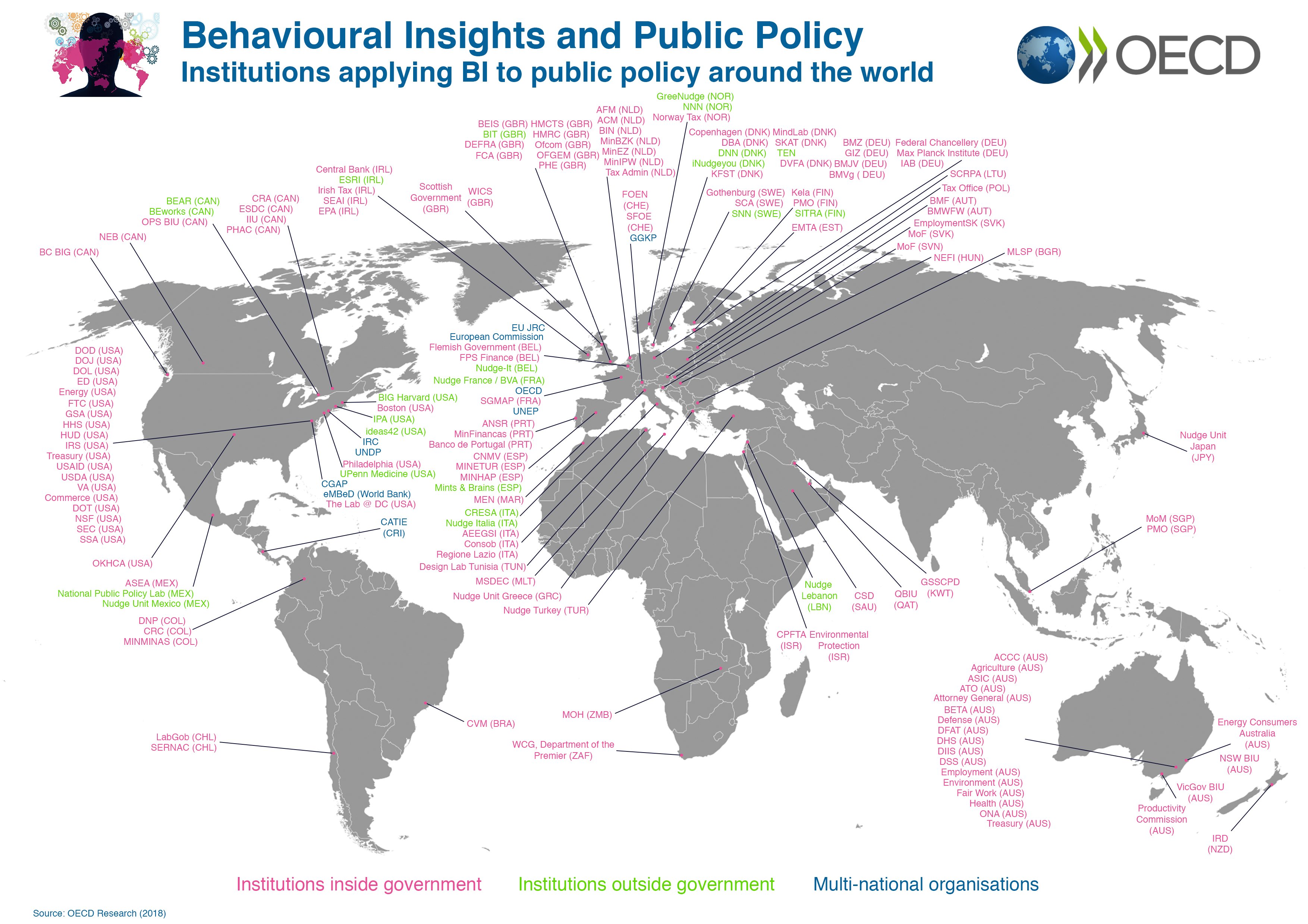
In its wake, governments over the world started to set up ministry-specific or administration-wide nudge units to apply these insights into the delivery of public policy. By 2018, the OECD identified more than 100 active public behavioural insights teams. At this point, it should be noted that the impetus was fuelled my the success of other popular books describing the limits of the rational agent model, notably (Ariely 2010Ariely, Dan. 2010. Predictably irrational: the hidden forces that shape our decisions. HarperCollins publishers.) and (Kahneman 2011Kahneman, Daniel. 2011. Thinking, fast and slow. Allen Lane.), and by the Nobel Prize2 Sveriges Riksbank Prize in Economic Sciences in Memory of Alfred Nobel awarded to Richar Thaler in 2017, thereby expressing an endorsement from the economics field of his approach.
In this domain, the relevance of such popular science books should not be underestimated. In order to initiate a change in the way policy is designed and delivered, you need to first convince policy-makers, that is politicians, and civil servants (and not just high-level ones). To this effect, popular science books are incredibly powerful. More often than not, it is after reading one of these books that people outside academia will call for behavioural insights expertise, and they’ll fully expect you to be familiar with their contents. But before I go further, I should probably define what public policy is.
1.4 What is public policy?
When you come from economics as I do, public policy is one of these terms that seem self-evident. Starting with Econ 101, you start thinking about the policy implication everything you see. So it came as a surprise when, in the fist instances of this class, students in this class asked me to tell them what public policy is. You work your way around taxes, bans, mandates, infrastructure investment, management incentives or market design. In a nutshell, we can assume for this class a very broad meaning for this term: public policy is any deliberate action by a public body undertaken in the pursuit of its mission.
In this light, one can define three main stages for public policy: definition, design and delivery.
1.4.1 Definition
This upstream step defines the goals and broad means of a public action. It starts with the identification of a problem which warrants public action.
Let’s take an example: low school achievement in socially disadvantaged neighbourhoods.
Pause here: why do you think this is a matter warranting public action? What are the ethical and practical reasons policymakers should care?
From a public policy perspective, it is a problem by itself: we know from studies that this low achievement level is not the result from innate low cognitive abilities, but form an adverse environment. Thus, these children are not given the liberty to live up to their full potential.3 This way to set up the normative aprt of the problem is close to capabilities theory. More on that in later sessions.
A consequential policy problem is that low school achievement translates into high unemployment and a higher risk of being involved in criminal activity. It thus makes sense to devote resources to improve school achievement in these areas even if you don’t particularly care about these people’s flourishing, but about the burden that crime or unemployment imposes upon the rest of society.4 From a normative point of view, I am moving the goalposts to a kind of limited utilitarianism. This kind of normative bait-and-switch is unfortunately common in public policy discussions.
1.4.2 Design
This step covers the choice of tools used to solve the problem.
Pause here: how would you design a policy to mitigate low school achievement in impoverished neighbourhoods?
In France, the Réseau d’éducation prioritaire framework reduces the number of children by class in primary school. Although the efficacy of this policy in general is not obvious (Filges et al. 2018Filges, Trine, Christoffer Scavenius Sonne-Schmidt, and Bjørn Christian Viinholt Nielsen. 2018. “Small Class Sizes for Improving Student Achievement in Primary and Secondary Schools: A Systematic Review.” Campbell Systematic Reviews 14 (1): 1–107. https://doi.org/10.4073/csr.2018.10.), it has been shown to work in the French case (Bougen et al. 2017Bougen, Adrien, Julien Grenet, and Marc Gurgand. 2017. Does Class Size Influence Student Achievement? No. 28. Institut des Politiques Publiques. https://www.ipp.eu/wp-content/uploads/2018/07/n28-noteIPP-Sept2017.pdf.).5 The French case lines well with other results which show that gains from small classes are more often observed on disadvantaged children than on the general population It also includes increased pay for teachers. The rationale for this higher pay stems from the fact that teachers in these neighbourhoods tend to be less experienced, and to leave for other places as soon as they can.
The policy thus bears (at least) three behavioural assumptions:
- Teachers will respond to this incentive by staying there longer, and that longer tenure translates in being more effective as a teacher and more engaged in local collective projects;
- Teachers will take advantage of the smaller class size to partially change their teaching methods to approaches more efficient for low-SES students;
- When in small groups, students will engage less in disruptive behaviours, and pay more attention to what they are taught.
1.4.3 Delivery
Delivery is the translation of your (hopefully) evidence-based design into a full-fledged public action, including all logistical, practical and symbolic constraints.
Pause here: how would you implement a policy corresponding to the above results? Can you think of alternative way to implement the same tools?
You’ll notice that the framing of the problem already implies some design choices. Instead of having a placed-based approach (disadvantaged neighbourhoods), one could have a revenue-based one (children from poor households), a family-structure one (children of single parents), etc… Each of these approaches is legitimate and grounded in solid research. The implicit choice of a place-based approach stems from the fact that the intuitive policy delivery tool – schools – is inherently place-based.
This example already underlines the relevance of a cognitive-behavioural approach to public policy: from the very early stage, public policy definition is framed by an intuitive understanding of the problem and the possible solutions. In this example, a researcher can credibly argue that the root of the problem lies in poor economic prospects for the parents of these children on from the run-down state and poor connectivity of these neighbourhoods – schools by themselves are only incidentally a part of the problem. However, it can be difficult to convince a policy-maker – a minister for example – that they have to change the way they think about an issue. Furthermore, cross-administrations policies are inherently more difficult to implement because of coordination costs and conflicting incentives.
In this example, the delivery stage will have to deal with a range of behavioural issues, for example:
- Pupils: it is documented that underachieving pupils often suffer from low self-esteem and low emotional regulation.
- Teachers: some teachers see their role as limited to cognitive performance, and will resists injunctions to devote time to teach emotion or attention regulation.
- Parents: some parents will try to avoid the perceived stigma associated with the REP+ classification. This can lead to pupils not benefiting from the policy, and to an outflow of higher-achieving pupils, making the segregation problem worse.
1.4.4 A self-examination moment
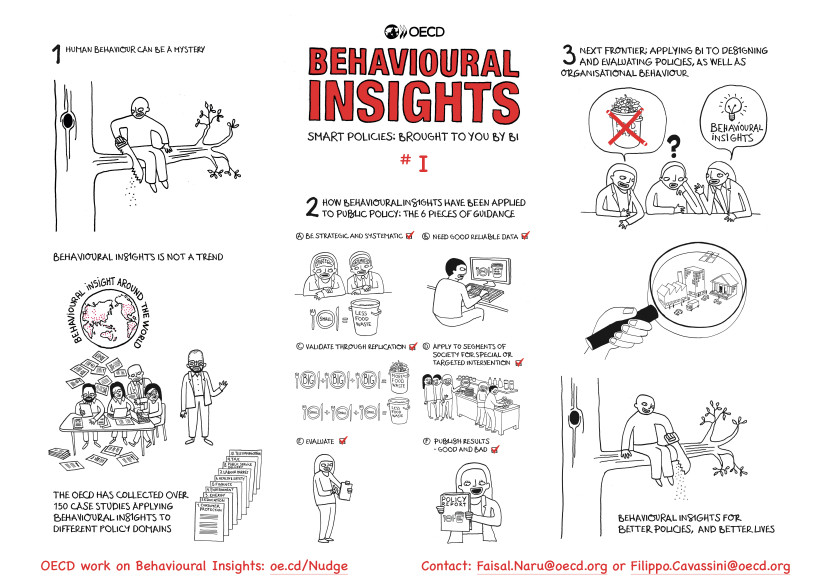
Before going further, let us consider this illustration from the OECD. It alludes to the (Schmidt et al. 2013Schmidt, K, Laurits Rohden Skov, A M Jespersen, Pelle Guldborg Hansen, Armando Perez-Cueto, and Bent Egberg Mikkelsen. 2013. “Smaller Plates, Less Food Waste: 20th International Congress of Nutrition.” Annals of Nutrition and Metabolism 63: 1754.) experiment which showed that providing smaller plates for lunch in professional settings decreased food waste. I a actually quite uncomfortable with this illustration. Could you spot why?
Figure 1.4: OECD illustration of BPP approach.
1.5 About this class
My goal for this class is to provide you with a working understanding on how behavioural science is used to design and deliver public policy, and a basic skills set for taking part in a real-world behaviourally-informed policy intervention. I will devote comparatively less time to presenting and explaining academic research. The scope of the relevant research is just too broad to give anything else than an overview. My approach is to introduce you to some landmark papers and reports from which you can work your way up to the relevant research in an applied setting. I also want this class to have a very strong applied component, so I’ll require you to actively participate through presentations and discussion.
Before covering that in detail, a few words about my teaching style. In a previous year’s evaluations, a student said that my classes sometimes sounded like TED talks. It was not intended as a compliment, but I think it is a fair assessment of what I actually do: present broad ideas, issues, solutions and research landmarks, leaving it up to you do go deeper into the literature.
1.5.1 General organization
TL;DR: One hour prepared lecture, one hour practical case, two full-length workshops to define and refine your projects, one full-length guest lecture. You are expected to work on your projects all along the term.
I tried to make the syllabus for this class as complete and informative as possible, with a full schedule, relations with other courses and resources. Odds are that you did not read it, or did not read it carefully enough. How do I know that?
 Figure 1.5: Paz (2021) took this photo to prove the USD 50 bill went unclaimed.
In 2021, a professor at the University of Tennessee at Chattanooga included in his syllabus a paragraph stating that he had deposited a $50 bill in a locker and providing the access code, allowing the first student to read the paragraph to have it (Paz 2021Paz, Isabella Grull’on. 2021. “Professor Put Clues to a Cash Prize in His Syllabus. No One Noticed.” The New York Times: U.S., December 18. https://www.nytimes.com/2021/12/18/us/professor-syllabus-money.html.). The bill went unclaimed for the whole term. There is no such Easter egg in my syllabus, but I urge you to read it carefully.
In my experience, two hours of lecture is not a cognitively optimal format. Students get tired, bored, or both, and I get bored to talk to a less and less attentive class. It is also suboptimal in terms of skills acquisition, since, what you’ll need in applied settings can only be acquired through practice. Thus, most of the sessions will have a two-parts structure: a flipped lecture and a practical case study.
In the first hour, we’ll cover what used to be a lecture topic.6 I used to give 1-h lectures. Following the 2023 work on neurodiversity, I started to provide the full text of the lecture ahead of the time, in order to accommodate various learning styles. This proved a challenge for some people, who felt the lecture what redundant with what they had already read. So I am experiencing with this new format. Adapting insights from the flipped classroom, I’ll start with a 20 mn refresher on the content of the course document, which I’ll assume you’ve read, and then we’ll have a 25 mn discussion on the points which you’ll select for elaboration.
I reserve the last 10 minutes of this first sequence for checking in on the progress of your project.
In the second hour, one of you will be presenting a practical case (most of the time a research paper), using a similar format: 20 mn presentation, followed by a prepared discussion.
1.5.2 Behavioural intervention project
A large share of your work for this class will go to an intervention project, conducted throughout the term. The main idea is to design a credible intervention on a specified behavioural issue. As you’ll quickly see, one of my articles of faith is that you need a detailed knowledge about the environment of your intervention for it to have a sporting chance to succeed. Hence, the scope of your intervention project will be your daily environment, meaning here the ENS-PSL environment. To date, I have asked students of this class to design interventions on:
- Reducing the ecological footprint of ENS-PSL
- Fostering the inclusion and achievement of neurodiverse students
- Help alleviate student procrastination, and time and attention management.
This year, you’ll work on how to foster a healthy use of digital devices by fellow students.
I elaborate below on my expectations for the project, but I’d like to highlight two things:
- You’ll need to work on your project all along the semester, starting at the end of this class: we’ll have regular check-ins.
- I want to be able to provide you with feedback on your final project during the last session of the class. This means you’ll have to hand over your final document for the one before last class (Dec. 12 this year). This moves forward the schedule compared to most project-based work. This will also free some time at the very end of the term.
1.5.3 Case studies and participation
Aside from this project, I use grading as an incentive to engage with the material of the class. In order to provide space for various way of engaging the content, you can self-select into several options.
Case studies Along with a knowledge of theories and concepts, applied behavioural insights require a strong attention to the practicalities of your project. You should learn to read research articles and reports with a keen eye on this aspect, which is often glossed over. I expect you to:
- Highlight strong and weak points of the project described;
- Identify missing elements of information;
- Challenge constructively expressed ideas and designs;
- Foresee practical implementation issue for a replication or scaling project.
Compared with the usual “journal club” format, the angle here is more applied. We’ll be less interested in Is this good science? (does the paper establish a new finding with a high standard of rigour?) than in Can I use that for an intervention?.
There are 6 case studies during the term, and only one person can present a case study at a time. This exercise requires you to be comfortable with speaking in front of the class.
Session feedback Along the general feedback on the whole course, I ask you to select a session and provide me with a detailed (2-3 pages) structured feedback. In this document, I expect you to tell be what worked and what did not on a specific session, and provide me with evidence-based suggestions on how to improve it. For example, a student of the 2024 session noticed that the variety of examples I used in one lecture made it more difficult to follow the narrative, the class coming across as an accumulation of disjointed mini-cases. He suggested, with references, that it would be better to use a smaller set of examples, including one I relied on in another class and which presented several of the relevant features.
Case study questions A bane of student-presented case studies is limited engagement from other students. I want to alleviate that through a ticket system. For each case study, there will be up to 4 spots, of tickets, for preparing and sending in advance, to the preparing student and to me, a written and detailed question or commentary (1-2 paragraphs) about the paper. The question or commentary may pertain to:
- The behavioural analysis performed by the paper;
- The behavioural levers used;
- The implementation of the experiment;
- The evaluation strategy and the interpretation of the results.
I expect your submission to answer the following questions in you question and remark:
- What motivates your question or remark (relevance / why should we care)?
- What did you expect to see in the experiment or in the paper?
- What are the likely consequences of our understanding of the results?
1.5.4 Evaluation
The final grade will be the weighted average of four sub-grades. Two are group-based (same grade for all members of the group):
- Midterm project: 30%, group-based. The grade is based on the written submission, with possible bonus points for the oral midterm presentation
- Final project: 30%. The grade is solely based on the final written submission.
And two are individual:
- One case study or one course feedback: 30%
- One written case study question: 10%
I’ll require you to work in groups. I know this can be a burden to some – and I am open to discuss privately with anyone for whom this is an issue – but both research and applied work in this area are team endeavours. So I ask you to set up work groups of 3-4 people as soon as possible, with the perspective that these groups will stay the same for the whole term. Groups will be the basic unit for the term-length project which will the basis for midterm and final evaluations.
1.6 Overview: where are we going?
I’ll briefly touch here upon each topic we’ll see during the lectures, the aim being to provide you with a broad overview of the scope of behavioural science we’ll be dealing with. In the feedback for the 2023 edition of this class, a student told me that he was initially put off by this section: why waste time with what we’ll see in more detail? However, he told me that because in the course of the semester, he found this bird’s eye view very useful to remind him where we were going. So, please pay attention, this is the roadmap for our travel together.
1.6.1 Behavioural biases, heuristics, and models of cognition
From an epistemic perspective, behavioural science is a field devoted to the study the departures of human behaviour from the rational choice theory and the Homo Economicus model. At the risk of being simplistic, the model utility-maximizing, rational people, using all available information through unlimited and instantaneous computing power became the central piece of policy analysis because of two separate reasons. On the one hand, rational decision theory sound like an acceptable normative approach to behaviour. Wouldn’t it be better if people did act upon a well-informed, well-understood self-interest? From the Smithian idea of the invisible hand to the apparent absurdity of observed behaviours (overeating, smoking, reckless driving, etc.), the normative ideal of rational agents is compelling. On the other hand, modelling economic agents as utility and profit maximisers constrained only by their initial resources allows for closed-form solutions of economic models. Closed-form solutions are useful because they make it possible to check for the internal consistency of the models (your conclusion are not dependent on a set of numeric parameters), and to built large-scale macroeconomic models used for budgeting and forecasting the impact of policies decisions in general equilibrium settings.
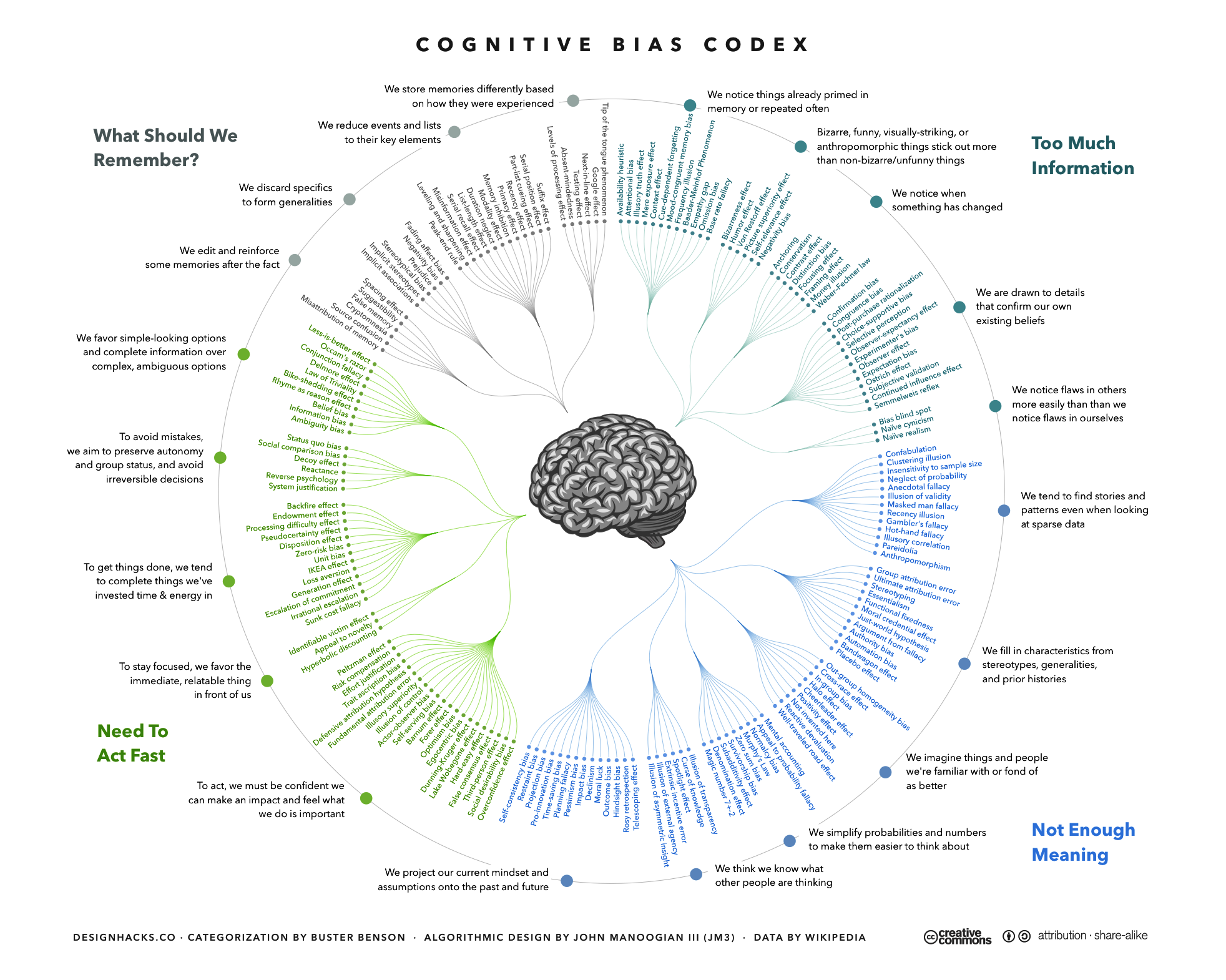
Of course, many researchers have been fully aware that the axioms of rational choice theory are routinely violated in actual, observed human behaviours. They began to document how, in controlled (laboratory) settings, you could observe such deviations from what the rational agent model predicts. The key insights was that the direction and the magnitude of these deviation are not random. People do not follow rational rules, but they do seem to follow some other rule. In the words of Dan Ariely, they are predictably irrational. Such departure from rationality were quickly labelled biases. Soon, research reliably identified tens of such situations. In a public policy lens, it means that, with regularity, people will unconsciously make choices they’ll later regret. Hence the idea to subtly change the decision environment in order to direct them to a choice they would have made if they had had time and energy to think about it. This is the whole point of Nudge.
Figure 1.6: An algothrimically-assisted classification of behaviours labelled as biases in Wikipedia
There is of course something unsatisfying in just documenting departures from rationality. Why do people do not act rationally, including in cases where it harms their self-interest with no discernible benefit?
Within the research community, Herbert Simon’s limited rationality and Kahneman and Tversky’s prospect theory provided alternatives to the rational agent model. From a policy perspective, one tipping point was the emergence of the dual system theory. The core idea of the dual system theory is that two decision-making circuits coexist in our minds. One is quick, intuitive, and follows simple heuristics which allow to react in a split second: I see a red light, I hit the brakes. The other system is slow, costly, rational, and is called upon where our brains identify that we are not in a situation covered by the System 1 heuristic. Problems arise when we meet a situation where the heuristic response is wrong, but the switch does not occur, or when the environment overloads the rational System 2, which defaults the decision to System 1.
While it is clear that the dual system theory is a simplification, it does provide a handy way to understand most biases. In terms on understanding, it seems to just kick the can further: where do there heuristics come from? Why and how have they been designed. In a policy perspective, the question is important: I want to know how much these heuristics can change: if people fully adapt to my interventions, all nudges are doomed to fail in the long run. The candidate explanation I rely on in this class is evolutionary psychology. The basic tenet is the idea that our brain is not an infinite computer, but an organic system shaped by millions of years of natural selection. Whenever our brain has to make a choice, its resources, most notably time, are limited. It thus makes sense that evolution selected approximate, energy-light rules (heuristics) to face the situations most commonly encountered. We can thus how how observed heuristics are actually second-best responses to environments and situations which were pervasive during our evolutionary history – and may not be as adaptive with the very recent (on the evolutionary time scale) apparition of complex societies (Page 2021Page, Lionel. 2021. Optimally Irrational: The Good Reasons We Behave the Way We Do. 1st ed. Elsevier.).
Policy-wise, it entails that fighting adaptive biases is misguided. Rather than trying to drive people towards a normative model of rational action, it can be more efficient to redesign public action around the actual cognitive strengths and weaknesses of human cognition – for example by making administrative tasks simpler and provide easy-to-understand, if slightly wrong, benchmark to help decision.
1.6.2 Frameworks
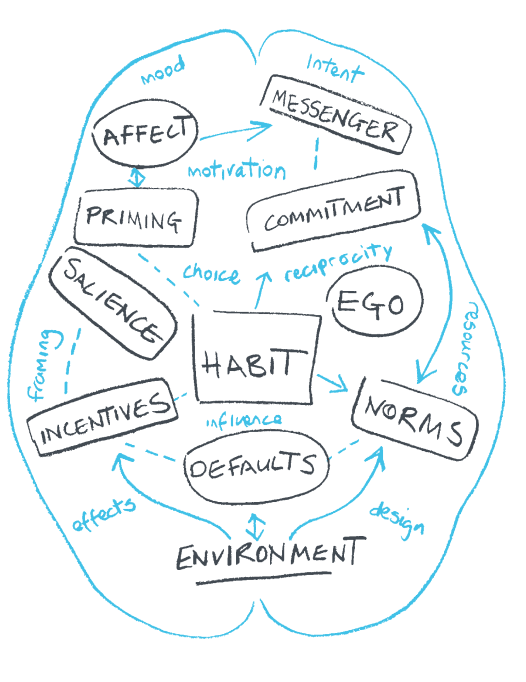 Figure 1.7: Cover picture for the seminal MINDSPACE framework.
Designing a behaviourally-informed public policy, even a small-scale intervention, is a complex task. Aside from the purely cognitive analysis – correctly identifying the behavioural issues and possible levers – you have to communicate your analysis and objective to a plurality of actors, and design you intervention in a way which integrates legal, social and practical constraints of your environment. More often than not, you’ll be relying on third parties for the actual delivery of your intervention. In order to help organize things, BI teams have set up several frameworks.
Simpler frameworks are a way to organise the growing number of documented biases into categories amenable to analysis and implementation, form example the MINDSPACE framework (Dolan et al. 2010Dolan, Paul, Michael Hallsworth, David Halpern, Dominic King, and Ivo Vlaev. 2010. MINDSPACE. The Behavioural Insights Team. https://www.bi.team/wp-content/uploads/2015/07/MINDSPACE.pdf.). Others are more action-oriented, intended to help the design of an effective intervention(BIT’s EAST) (Service et al. 2014Service, Owain, Michael Hallsworth, David Halpern, et al. 2014. EAST: Four Simple Ways to Apply Behavioural Insights. The Behavioural Insights Team. https://www.bi.team/publications/east-four-simple-ways-to-apply-behavioural-insights/.). Over the years, frameworks have emerged which cover the whole life-cycle of a project, such as the OECD BASIC framework (OECD 2019OECD. 2019. Tools and Ethics for Applied Behavioural Insights: The BASIC Toolkit. Doi:https://doi.org/10.1787/9ea76a8f-en. https://www.oecd-ilibrary.org/content/publication/9ea76a8f-en.), including ethics, evaluation and the scaling-up phase. Frameworks are thus powerful tools to manage your own work and to communicate (and reassure) partners. They can also become a constraint, or, if badly used, empty tick-the-box exercises. We’ll review some of the main frameworks in order to help you understand their workings and select the more relevant for a given project.
1.6.3 Cooperation and reciprocity
In laboratory settings, cooperative games have been largely used to show that people cooperate more often and more widely than what the rational choice theory would predict. These studies also show a high prevalence of behaviours which defend and sustain social norms at an individual cost. For example, most people are ready to sacrifice some of their gains in order to punish another players suspected of some dishonest or unfair behaviour, or even to ensure more event outcomes of random lotteries. Thus, rather than generalized competition mediated by formal or informal markets, conditional cooperation is the most common observed behaviour.
Research show that some of our basic cognitive capabilities have been honed (selected) to allow and sustain regular cooperation in human societies. We naturally pay attention to faces, facial expression and gazes, and have strong cognitive routines for detecting cheaters and gathering information about peers and potential partners. All these behaviours condition the way interventions will play out in the field: the social dimension cannot be limited to a behavioural lever (tell your friends you’re quitting smoking), but as a full environmental factor which interacts in complex ways with any intervention (Oliver 2019Oliver, Adam. 2019. Reciprocity and the Art of BPP. Cambridge University Press. https://doi.org/10.1017/9781108647755.).
1.6.4 Test of time: Present bias and procrastination
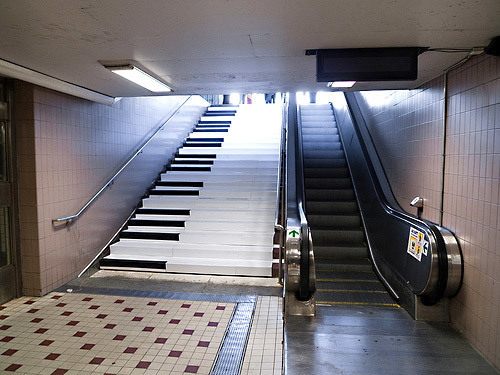 Figure 1.8: Picture of the piano staircase at Rotterdam Central Station
In order to attain relevance, behavioural interventions need to lead to sustained changes in behaviours. The piano staircase idea is for me a case in point. To put it briefly, motion sensors and a sound system are installed in a flight of stairs so that people walking on the stair (rather than taking the elevator) produce sounds – making taking the stairs more fun. Even in the favourable assumption that the novelty effect does not fade too much for regular commuters, this set-up would have achieved only punctual behavioural change: taking one flight of stairs while a typical commuting contains many, and a corresponding small health benefit. Surely, we should do better.
Procrastination, the human tendency to postpone actions with upfront costs and delayed gains, constitute a major obstacle to sustained behavioural change. It is also a common denominator of some of the most severe health problems in our societies, from smoking to obesity, including sedentarity, and our collective failure to set up an efficient preventive health system. Overcoming procrastination often require a set of behavioural devices combining rewards, social pressure and commitment devices. It thus represents a rich set of examples of multilayered behavioural interventions.
1.6.5 Out of the WEIRD space and scarcity mindset
A common criticism of experimental psychology has been that the sample of individuals is often drawn from a WEIRD population: Western, Educated, Industrialized, Rich and Democratic – basically, American college students. This questions the external validity of an understanding of human cognition derived from such a specific sample. The development of research teams in non-Western countries and a selection of more diverse samples has alleviated some of this criticism, but in terms of policy action, the proof is in the pudding: behaviourally-informed intervention have already been deployed at a large scale in emerging countries. However, policy-making ever in WEIRD countries tend to ignore the fact that exposure to poverty or deprivation triggers a set of adaptive behaviours which linger for a long time, sometimes for a lifetime. A familiarity with these adaptation help design relevant intervention targeted at the more fragile segments of society.
Within rich countries, behavioural research has highlighted that the experience of precarity and poverty leads to behavioural adaptations, the scarcity mindset which differs in key dimensions from the choices people with no experience of poverty would make.
1.6.6 Fairness and acceptability
Among social norms, those defining what is understood as fair in any given society are of paramount importance for policy-making. These can break a policy at a large and small scale. The inheritance tax and the carbon tax are two examples of policies which are near-consensual among experts and very strongly resisted by populations. If mistaken beliefs play a role in this rejection – people wildly overestimate their odds of ever receiving a taxable amount of inheritance – concern about fairness are key to this rejection. At a smaller scale, many interventions have been marred but the refusal from people actually implementing the intervention to adhere to the experimental protocol, on the ground that it was unfair. Typically, the random allocation of people in treatment or control conditions violate deep-seated norms of equal treatment, or of efficient action (providing additional resources to those more likely to make the most of it). Thus, behavioural interventions should pay careful attention to the fairness norms likely to be activated – on top of common concerns about the ethics of behavioural interventions per se (Sunstein 2014Sunstein, Cass R. 2014. The Ethics of Nudging. SSRN Scholarly Paper ID 2526341. Social Science Research Network. https://doi.org/10.2139/ssrn.2526341.). In other words, you need to have some idea of the political economy of your behavioural public policy (Oliver 2023Oliver, Adam. 2023. A Political Economy of Behavioural Public Policy. Cambridge University Press. https://doi.org/10.1017/9781009282574.).
On the other hand, we know that acceptability norms evolve over time. What we are more likely to miss is how quickly they can change, especially through behavioural cascades (Frank 2020Frank, Robert. 2020. Under the Influence. Princeton University Press. https://press.princeton.edu/books/hardcover/9780691193083/under-the-influence.). Understanding these dynamics helps designing intervention which can sustain behavioural change in the long run through information provision and deliberate affirmation of new norms.
1.6.7 Climate
The need for a global transition towards more sustainable ways of living is probably the main challenge of our time. The use of behavioural insights, under the headline of green nudges, have been highlighted as part of the solution. There is a vast literature harnessing the field to foster more eco-friendly behaviours, down to UN-endorsed practical guides, such as (United Nations Environment Programme et al. 2020United Nations Environment Programme, GRID-Arendal, and Behavioural Insights Team. 2020. The Little Book of Green Nudges: 40 Nudges to Spark Sustainable Behaviour on Campus. UNEP and GRID-Arendal. https://www.unep.org/resources/publication/little-book-green-nudges.). However, the relevance of this approach is hotly debated. The terms of the debate itself are actually not specific to the ecological transition.As in other areas of application, they center on an eviction effect (Chater and Loewenstein 2022Chater, Nick, and George Loewenstein. 2022. “The i-Frame and the s-Frame: How Focusing on Individual-Level Solutions Has Led Behavioral Public Policy Astray.” SSRN Scholarly Paper No. 4046264. Rochester, NY, Pre-published March 1. https://doi.org/10.2139/ssrn.4046264.), whereby the multiplicity of individual-based intervention distract resources from systemic changes, and how far the risk posed by climate change would allow to bend the usual ethical rules of behavioural public policy (DesRoches et al. 2023DesRoches, C Tyler, Daniel Fischer, Julia Silver, et al. 2023. “When Is Green Nudging Ethically Permissible?” Current Opinion in Environmental Sustainability 60 (February): 101236. https://doi.org/10.1016/j.cosust.2022.101236.).
In this lecture, I’ll cover a range of experiment and explore this debate.
1.6.8 Institutional space
As we saw earlier, there is now a large number of BI teams around the world. Some function as independent consultancies, other are embedded within administrations (central or local). For this session, I invited a member of the French behavioural insights unit at the Direction Interministérielle de la Transformation Publique (DITP). She’ll map for you some of the main actors in France, and walk you through and end-to-end analysis of an actual policy intervention.
A key feature of this session is that you’ll have someone who is both an behavioural science expert and a seasoned practitioner to answer your questions. I highly recommend you prepare your questions in advance.
1.6.9 New Frontiers
For most of this class, we’ll be studying attempts to use behavioural insights to improve peoples’ lives. This last lecture will cover the flip side of these tools: how behavioural levers are used, consciously or not, to take advantage of people and what can be done about it. Among administrations, lopsided incentives too often result in uselessly complex, cognitively costly procedures – something Thaler and Sunstein call sludge (Thaler 2018Thaler, Richard H. 2018. “Nudge, Not Sludge.” Science 361 (6401): 431–31. https://doi.org/10.1126/science.aau9241.). Through the practice of behaviourally-informed sludge audits, behavioural researchers can improve access and efficiency of policy action, both in private and public administration (Sunstein 2020Sunstein, Cass R. 2020. “Sludge Audits.” Behavioural Public Policy, January 6, 1–20. https://doi.org/10.1017/bpp.2019.32.). Here again, the political economy aspect is paramount to understand the set of incentives which gave birth to cumbersome procedures – including at times a deliberate intend to reduce access to rights.
Since they are deeply rooted in human cognition, the kind of behaviours leveraged by behavioural insights are nowhere new, at least at the scale of human societies. They have been identified, used, throughout human history: ancient Greek and Roman rhetoric manual already contain large catalogues of what we know term biases and how to use them for your own advantage. Closer to us, advertising, management and communication widely rely on behavioural biases. Digital interfaces have given old tools a much larger scope: many website include designs which leverage fear of missing out (think social networks), loss aversion and reactions to scarcity (only one item left in stock!). Taken as a whole, this practices are now regrouped under the dark patterns label . Since we established that these gut reactions cannot be fully neutralized through conscious action, there is a strong case for state intervention, regulating the use of these devices. Alongside behaviourally-informed policy delivery, behaviourally-informed regulation becoming a very significant field of intervention.